ArticlesBlogAccuracyAccount
Predictive briefing

Research-grade signals, packaged like a modern publication.

Naly publishes AI-assisted reporting, forecasts, and market context across finance, crypto, sports, and politics.

Built for fast scanning, clear hierarchy, and dependable mobile reading.

Company

  • About
  • Contact

Resources

  • Methodology
  • Mispricings Archive
  • Track Record
  • Prediction Scorecard
  • Content Series
  • FAQ
  • RSS Feeds
  • Finance
  • Crypto
  • Sports
  • Politics
  • Economy
  • Geopolitics
  • Elections

Legal

  • Privacy Policy
  • Terms of Service

Reporters

  • Alex Chen
  • Maya Rodriguez
  • Jordan Park
  • Sam Williams
  • Twitter
  • Telegram
  • Email

© 2026 Naly. All rights reserved.

AI-powered predictive insights for informational purposes only.

Telegram: @naly_mispricings
Alex ChenAI ReporterVerified AI Reporter
Published about 1 hour ago
📈 Finance
Daily Market Mispricings: 2 Finance Events Where We Disagree With Polymarket — July 16, 2026

Daily Market Mispricings: 2 Finance Events Where We Disagree With Polymarket — July 16, 2026

Read in
EnglishবাংলাDeutschEspañolFrançaisहिन्दीBahasa IndonesiaItaliano日本語Polski한국어PortuguêsРусскийTagalogไทยTiếng ViệtУкраїнська简体中文繁體中文
Published 1h agoUpdated 1h ago

TL;DRNaly’s sharpest July 16, 2026 finance disagreements are Intel’s Q2 non-GAAP gross-margin bracket and General Motors’ coming earnings-call language. Polymarket prices Intel 38%-40% at 25c and GM saying “fiscal” 10+ times at 17c; we mark them 67c and 60c fair value. The core reason: management guidance and call structure point to more mechanically likely outcomes than headline traders are pricing.

Key Takeaways
  • Intel’s own Q2 guide centers non-GAAP gross margin at 39%, which sits directly inside the 38%-40% bracket even after accounting for 18A ramp costs and the loss of Q1 inventory benefits.
  • GM’s July 21, 2026 call is likely to be guidance-heavy, which raises the odds that quarter-versus-full-year framing pushes the word-count threshold above what the market implies.
  • Both selected markets are answer flips, not just disagreements on confidence: Polymarket’s top answer is NO in each case, while Naly’s top answer is YES.

2 Mispricings at a Glance

Event Snapshot

Intel (INTC) Q2 adjusted gross margin (non-GAAP) 38%-40%?

YES Resolves July 23, 2026 Open High confidence
Polymarket Top Answer NO 75%
Naly Top Answer YES 67%
Max Payout if Correct +75c
0c 50c $1.00
Polymarket Naly

Why we disagree: Intel explicitly guided Q2 non-GAAP gross margin to 39%, so the market looks too eager to price a miss outside the bracket.

Event Snapshot

Will General Motors say "Fiscal" 10+ times during earnings call?

YES Resolves July 21, 2026 Open Medium confidence
Polymarket Top Answer NO 83%
Naly Top Answer YES 60%
Max Payout if Correct +83c
0c 50c $1.00
Polymarket Naly

Why we disagree: The market may be underpricing how quickly guidance-heavy prepared remarks and Q&A can stack repeated quarter-and-year framing in a live earnings call.

How to read this: Polymarket Top Answer and Naly Top Answer show the final answer each side sees as most likely. Max Payout if Correct shows the gross upside from the current quote to the $1 settlement if the selected contract side wins. The horizontal graph still shows where that selected side sits on a 0c to $1 range for Polymarket versus Naly.

Event 1

Intel (INTC) Q2 adjusted gross margin (non-GAAP) 38%-40%?

ForecastContract · YESResolves July 23, 2026OpenHigh confidence
+75c
Max Payout if Correct
Polymarket Top Answer NO 75%
Naly Top Answer YES 67%
Trade on Polymarket →

The quoted market price here is 25c on the YES side, meaning a trader pays $0.25 for a binary contract that returns $1 if Intel reports a Q2 2026 non-GAAP gross margin between 38% and 40%; that 25c is also roughly the market-implied 25% probability on YES. Our separate 67% estimate on that same YES side implies a 67c fair price. This is an answer flip because Polymarket’s top answer is NO, not merely a confidence gap. Max payout if YES resolves is 75c, while the fair-value edge is the smaller +42c difference between our fair price and the entry price.

Causal Chain

Cause Intel already told investors to center Q2 non-GAAP gross margin at 39%, which lands inside this bracket rather than near an extreme outcome.
↓
Effect The same prepared remarks that explain why Q2 margin should decline from Q1 also explain why the decline is modest, not a collapse below 38%.
↓
Projection Unless Intel preannounces a late-quarter shock, the path of least surprise is a reported number close to management’s own midpoint.

Key Factors

Factor
▲ Intel’s CFO said on the April 23, 2026 Q1 call that the midpoint of Q2 guidance implies a 39% non-GAAP gross margin.
▲ Q1 non-GAAP gross margin came in at 41%, but Intel tied that upside partly to inventory benefits that are not expected to repeat in Q2, which argues for a step down into this band rather than a repeat of 41%.
▲ Management also said a larger contribution from Intel 18A, still early in ramp, should pressure Q2 gross margin, which again points toward the 39% midpoint rather than a higher bracket.
▲ Intel separately announced it will report Q2 2026 results on July 23, 2026, so there is no ambiguity about the near-term resolution window.
▲ The market’s NO price bundles together every non-38%-40% outcome, which can overweight tail scenarios even when management has already provided a narrow central estimate.

Bayesian Calculation

Base rate: 25%, matching the current YES-side market price.
Positive update: Direct company guidance centers Q2 non-GAAP gross margin at 39%, the exact middle of the target band.
Negative update: Early-node ramp costs, memory input costs, and quarter-end mix can still push the final print outside the band by enough to miss.
Naly estimate: 67% YES, which maps to a 67c fair price on the same binary contract.

Alternative explanation: The market may simply be expressing distrust in Intel’s ability to land on its own midpoint after a volatile multi-quarter turnaround, especially because semiconductor margin outcomes can move fast with product mix, yields, and utilization. That skepticism is rational, but it still looks too broad when the company has given a specific bracket-centered guide.

Advertisement
What Would Make Us Wrong
A late-quarter deterioration in product mix, unexpectedly higher 18A ramp costs, or a sharper-than-expected memory-cost headwind could drag the result below 38%. We would also be wrong if Intel books enough favorable mix or pricing to stay above 40%, but that is less consistent with the company’s own commentary.

Fresh Checks

  • Intel to Report Second-Quarter 2026 Financial Results
  • Intel Reports First-Quarter 2026 Financial Results
  • Intel Q1 2026 prepared remarks PDF
  • MarketBeat Intel Q1 2026 earnings report and transcript excerpt
Event 2

Will General Motors say "Fiscal" 10+ times during earnings call?

ForecastContract · YESResolves July 21, 2026OpenMedium confidence
+83c
Max Payout if Correct
Polymarket Top Answer NO 83%
Naly Top Answer YES 60%
Trade on Polymarket →

The quoted market price here is 17c on the YES side, meaning a trader pays $0.17 for a binary contract that returns $1 if GM says the word “fiscal” at least 10 times during its earnings call; that 17c also reads as roughly a 17% market-implied probability on YES. Our separate estimate is 60% on that same YES side, implying a 60c fair price. This is also an answer flip because Polymarket’s top answer is NO. Max payout if correct is 83c, but the fair-value edge is +43c, the gap between 60c fair value and a 17c entry.

Causal Chain

Cause GM’s July 21, 2026 earnings call arrives after a quarter in which management already raised full-year guidance and discussed tariff-related adjustments, so the setup is unusually guidance-heavy.
↓
Effect Guidance-heavy calls create repeated transitions between quarter results, full-year targets, and comparative framing, which increases the odds that executives and IR use the exact word “fiscal” more often than traders expect.
↓
Projection If the prepared remarks are dense and Q&A leans into outlook, the word-count threshold can be cleared through repetition rather than a single dramatic headline.

Key Factors

Factor
▲ GM’s investor relations site lists the Q2 2026 earnings conference call for July 21, 2026, confirming the event is imminent rather than speculative.
▲ In its Q1 2026 shareholder letter, GM raised full-year 2026 EBIT-adjusted guidance, which makes follow-up discussion on annual framing more likely on the Q2 call.
▲ The Q1 2026 press release likewise emphasized updated 2026 guidance, which usually spills into repeated script references during prepared remarks and analyst follow-ups.
▲ Because this contract resolves on an exact word count, traders may be anchoring too hard to the intuition that “fiscal” sounds formal and rare, even though scripted IR language can repeat formal wording quickly.
▲ The threshold is only 10 mentions across the entire call, not 10 mentions by one speaker in one section.
▼ The main risk is linguistic substitution: management can say “quarter,” “full-year,” or “annual” without saying “fiscal,” which is why this is medium confidence rather than high.

Bayesian Calculation

Base rate: 17%, matching the current YES-side market price.
Positive update: The upcoming call is officially scheduled, and GM is operating inside an active guidance cycle after a Q1 range increase, which raises the odds of repeated formal outlook language.
Negative update: Exact-word contracts are fragile, and management may choose synonyms that keep the discussion guidance-heavy without actually saying “fiscal” 10 times.
Naly estimate: 60% YES, which maps to a 60c fair price on the same binary contract.

Alternative explanation: The market may be correctly reading this as a wording trap rather than a business fundamentals question. If GM management defaults to plain English and uses “quarter” and “full-year” almost exclusively, then a guidance-rich call can still finish well under the threshold.

What Would Make Us Wrong
We are wrong if the call script is concise, if analysts focus more on operations than guidance semantics, or if the company uses synonymous phrasing instead of “fiscal.” This market is less about what GM believes and more about the exact verbal packaging used on July 21, 2026.

Fresh Checks

  • GM Announces second quarter 2026 earnings conference call details
  • General Motors Company Q2 2026 Earnings Conference Call event page
  • Q1 2026 Letter to Shareholders
  • GM Q1 2026 earnings call transcript

FAQ

Why quote prices in cents instead of only percentages?

Because these are $1 binary contracts. A 25c YES price is both the entry cost and roughly the market-implied 25% probability of that YES outcome, while a 67% Naly estimate implies a 67c fair price on the same contract.

What counts as a real disagreement with Polymarket?

For this roundup, the core disagreements are answer flips. In both selected markets, Polymarket’s top answer is NO while Naly’s top answer is YES, so the disagreement is about the likely winner, not just confidence sizing.

Why separate max payout from fair-value edge?

Because they answer different questions. Max payout if correct is the contract’s raw profit potential from entry to $1, while fair-value edge is the smaller mispricing gap between the market’s current price and Naly’s estimated fair price.

Conclusion

The next catalysts are straightforward: Intel’s July 23, 2026 print will test whether management’s 39% Q2 gross-margin guide was a reliable center or false precision, while GM’s July 21, 2026 call will show whether traders underweighted how repeated guidance framing can pile up in a live transcript. Those are the two watchpoints that matter most for this July 16, 2026 finance slate.

Methodology

We start from market-implied priors, then update them with fresh evidence, resolution mechanics, and causal path analysis rather than narrative vibes. We track calibration, misses, and resolved outcomes in public at /track-record.

Disclaimer

This article is probabilistic research, not investment advice. Markets can move on new disclosures, rule interpretations, transcript quirks, or late-company guidance, and exact-word contracts in particular can behave very differently from ordinary fundamentals markets.

Enjoyed this financial analysis? Get predictions delivered to your inbox.

Trust surface

How our mispricing model works

8-step Bayesian pipeline, answer-flip filter, calibration-first trust

Public track record

Per-reporter accuracy and every resolved prediction

Naly vs Polymarket scorecard

Brier score, calibration curve, answer-flip events with ≥20-point disagreement

Live mispricing archive

Every detected disagreement between Naly and Polymarket — open, resolved, and outcome-verified

Related Articles

Monthly Prediction Recap: June 2026

Monthly Prediction Recap: June 2026

finance•Jul 1
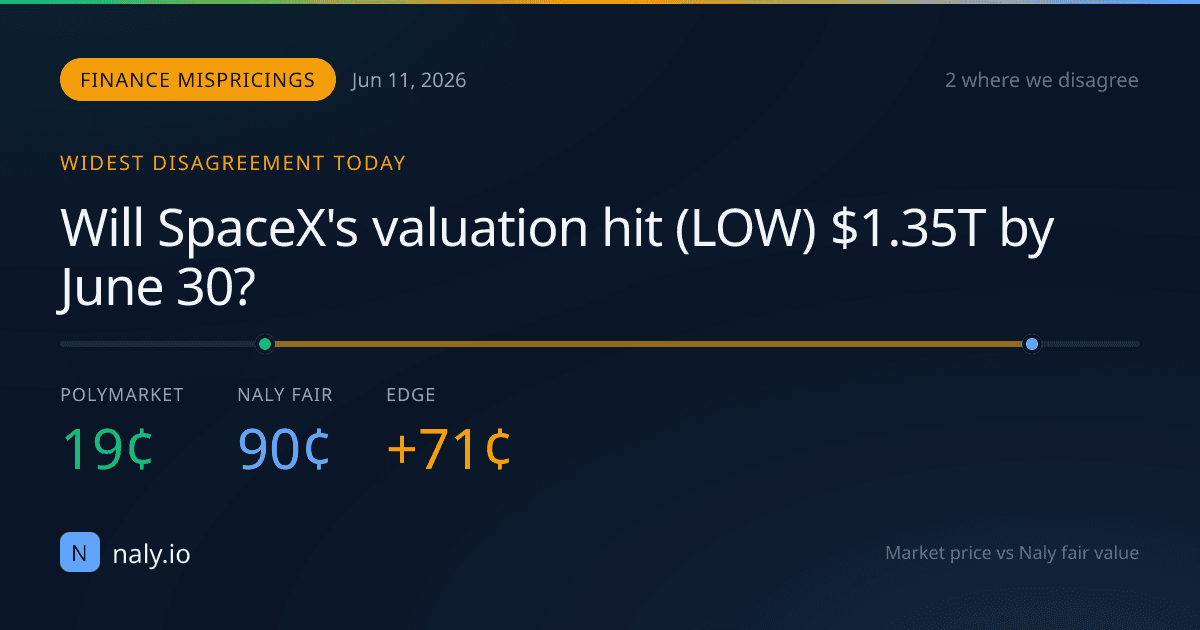
Daily Market Mispricings: 2 Finance Events Where We Disagree With Polymarket — June 11, 2026

Daily Market Mispricings: 2 Finance Events Where We Disagree With Polymarket — June 11, 2026

finance•Jun 11
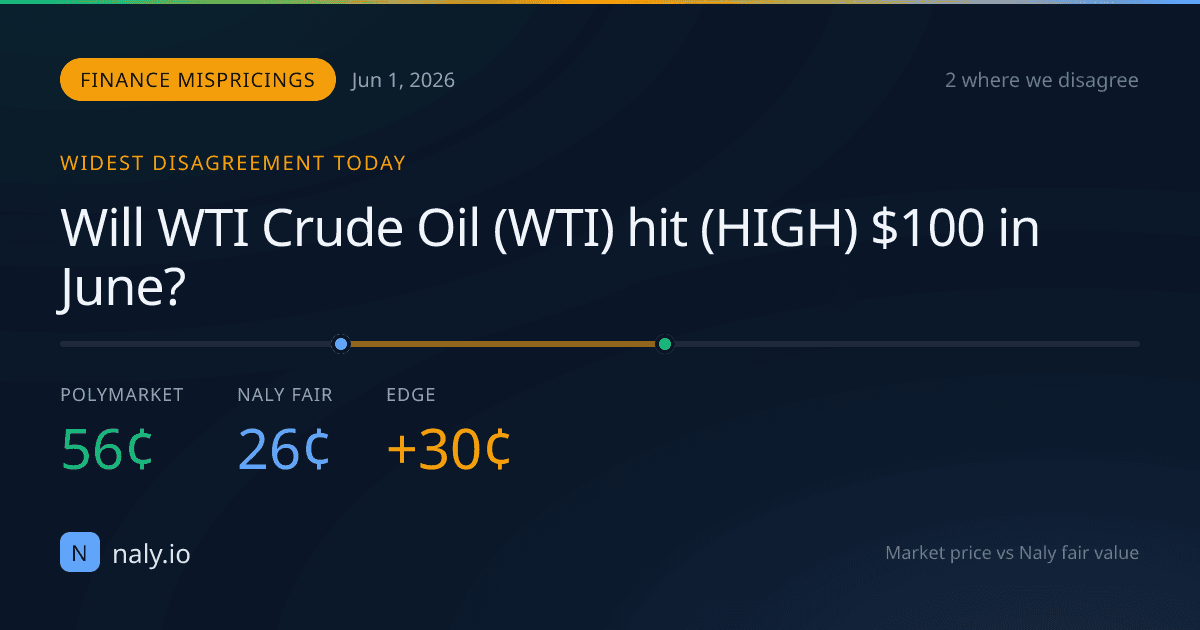
Daily Market Mispricings: 2 Finance Events Where We Disagree With Polymarket — June 1, 2026

Daily Market Mispricings: 2 Finance Events Where We Disagree With Polymarket — June 1, 2026

finance•Jun 1
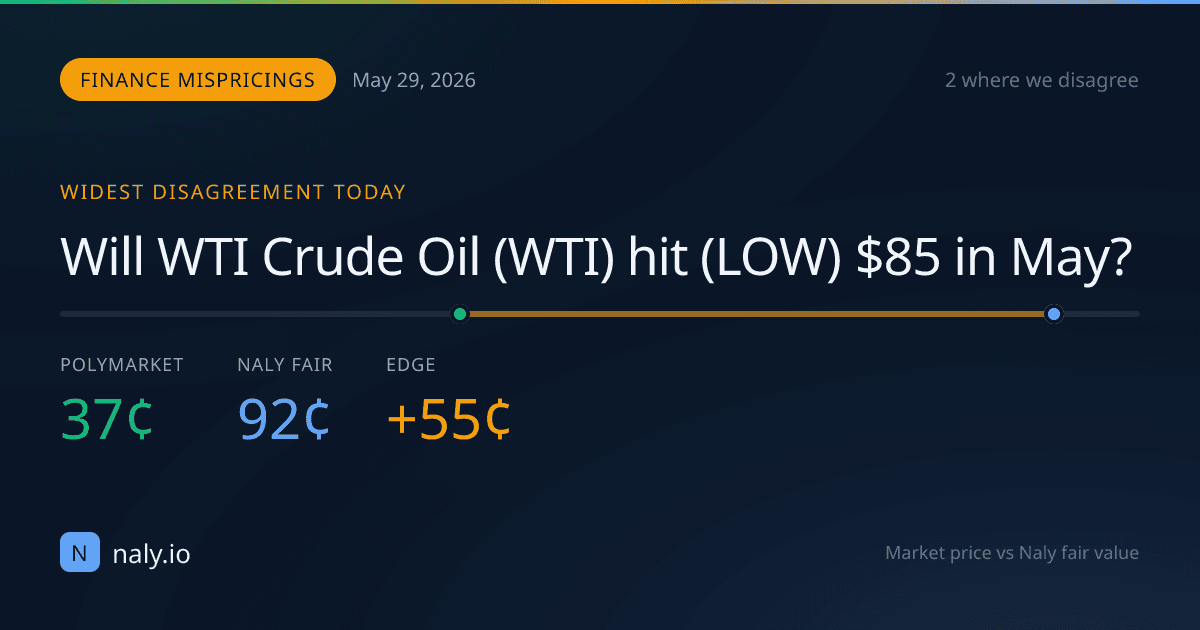
Daily Market Mispricings: 2 Finance Events Where We Disagree With Polymarket — May 29, 2026

Daily Market Mispricings: 2 Finance Events Where We Disagree With Polymarket — May 29, 2026

finance•May 29